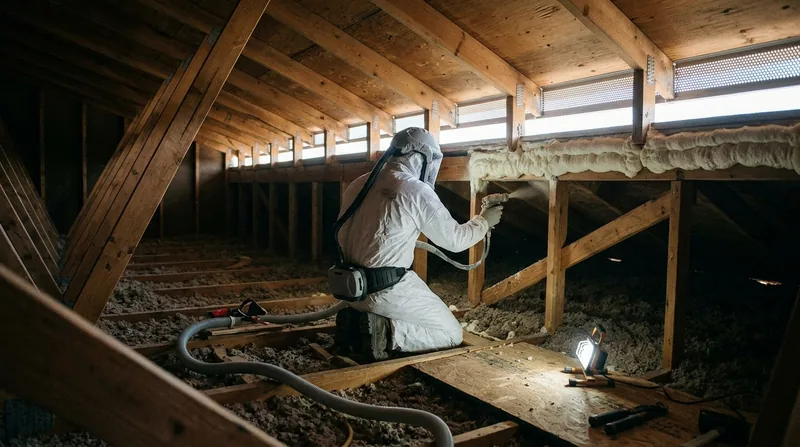




Wind-driven dust and summer heat find their way into Midland homes through gaps around top plates, electrical penetrations, and ductwork chases that vented attics leave unsealed. Air sealing in Midland closes those leaks so your cooling stays inside during hundred-degree days and cold snaps in winter do not pull drafts through the attic deck. On the high plains of the Permian Basin, where nearly every house sits on a slab with ductwork running through a vented attic, air leaks are the fastest way to lose conditioned air and let dust and heat find their way past your insulation. We identify those gaps, seal them with spray foam or caulk, and pair the work with attic insulation so the two systems work together. The result is lower energy bills, better comfort in back bedrooms that never seemed to cool, and fewer dust storms inside the house when West Texas wind picks up.
Why Air Sealing Matters in Midland's Hot, Dry Climate
Midland's summer heat and winter cold expose every air leak in the building envelope. Vented attics in older brick ranches and newer subdivisions pull conditioned air up and out through top-plate gaps, electrical boxes, and around HVAC penetrations. In summer, that loss means your air conditioner runs longer to cool the same square footage. In winter, cold air sneaks in the same paths and creates drafts in living spaces. The Permian Basin's wind also drives dust and caliche through unsealed gaps, which settles in ductwork and reduces airflow. Air sealing stops that waste by closing the gaps before they cost you money and comfort.
- We locate air leaks around electrical outlets, light fixtures, and HVAC penetrations in the attic.
- We seal top plates where the attic meets the exterior walls with closed-cell or open-cell foam.
- We close gaps around ductwork runs and return-air chases so conditioned air stays in the system.
- We address rim joists and band joists where the rim meets the foundation, a common leak path in slab homes.
- We combine air sealing with blown-in or spray foam insulation so both systems reinforce each other.
Sealing these paths is the fastest way to improve attic performance and lower cooling costs in Midland's climate.
Key info: A mid-century brick ranch in central Midland with a vented attic and loose top-plate sealing will lose 20 to 30 percent of its conditioned air to the attic before it reaches the back bedrooms. Air sealing that top plate can recover much of that loss and drop summer cooling costs by 10 to 15 percent.
For more on how insulation and air sealing work together, see our guide to attic spray foam insulation in Midland.
How We Seal Air Leaks in Midland Attics and Walls
Air sealing starts with a walk through your attic to find where air is moving. We look for light leaks around electrical boxes, gaps at the top plate where the attic meets the exterior wall, and any space where ductwork or HVAC lines pass through. Once we map the leaks, we use spray foam or caulk to close them. For large gaps and top-plate sealing, we apply closed-cell or open-cell foam to the full depth of the gap. For smaller penetrations and electrical outlets, we use fire-rated caulk. Every seal is made to code and designed to last without settling or shrinking away from the edges.
- We inspect the attic and identify all air leaks using visual inspection and thermal imaging if needed.
- We prepare the surface by cleaning dust and debris so foam or caulk bonds fully.
- We apply spray foam to top plates and large gaps, filling the entire depth and width of the void.
- We use fire-rated caulk on smaller electrical penetrations and light-fixture gaps.
- We provide mechanical ventilation during cure so fumes clear and re-entry is safe in 24 to 48 hours.
- We coordinate air sealing with blown-in or spray foam insulation so both jobs reinforce the thermal envelope.
The goal is a continuous seal that stops air movement without trapping moisture or creating a fire risk.
Example: A newer home in West Odessa with a sealed attic and ductwork running through the conditioned space needs air sealing around the ductwork penetrations and rim joists. We seal those paths with closed-cell foam so the attic stays dry and ductwork losses drop to near zero.
Learn more about our closed-cell spray foam work and how it stops air movement and moisture.
Air Sealing Methods and Best Applications
| Approach | Description | Best for |
|---|---|---|
| Closed-Cell Foam Sealing | High-density foam that hardens into a rigid seal with an R-value of 6 to 7 per inch. Stops air and vapor movement. Adds structural strength. | Top plates, rim joists, large penetrations, and sealed attics where moisture control matters. |
| Open-Cell Foam Sealing | Lower-density foam that cures to a soft, flexible seal with an R-value of 3.5 to 4 per inch. Allows some vapor transmission. Lower cost. | Vented attics, wall cavities, and sound-dampening applications where vapor can escape. |
| Fire-Rated Caulk | Paintable sealant that meets fire code for electrical boxes and light fixtures. Stays flexible, easy to cut and paint over. | Electrical penetrations, small gaps around trim, and areas where spray foam would be overkill. |
| Foam Backer Rod and Caulk | Compressed foam rod inserted into a gap, then sealed over with caulk. Controls depth and reduces caulk use. Paintable. | Wide gaps at top plates, around ductwork chases, and areas where a full foam fill is not needed. |
Air Sealing Cost in Midland: What to Expect
Air sealing jobs in Midland start at $650 for a small, targeted seal of a few top-plate sections or rim-joist gaps in a modest home. Most homes fall into the $1,200 to $2,500 range once the full attic top plate and major penetrations are sealed. Larger homes, homes with complex ductwork layouts, or jobs that include both air sealing and blown-in insulation typically run $2,500 to $4,500. The cost depends on how many linear feet of top plate need sealing, the number of penetrations, attic access difficulty, and whether you are combining air sealing with insulation. A home in Midland with a straightforward vented attic and accessible top plates costs less than a sealed attic with multiple HVAC chases or a metal building where ductwork runs through the structure.
The best way to know what your job will cost is to call us at (432) 400-5155 for a free estimate. We inspect your attic or crawl space, measure the linear feet of sealing needed, and give you a written price with R-value and thickness specs so you know exactly what you are paying for. We also help you understand whether air sealing alone is the right move or whether pairing it with insulation replacement makes sense for your home. Getting two or three estimates from different contractors is smart so you can compare approach and price.
See our full pricing overview for more detail on what drives cost and what is included at each tier.
Air Sealing Near Me: What Midland Homeowners Should Know Before Hiring
Air sealing is not regulated by a state license in Texas, but your city or county may require a contractor to register before pulling a permit. Before you hire any spray foam or insulation contractor, ask them whether your city requires contractor registration and ask to see proof. Verify their insurance coverage and make sure they carry general liability and workers compensation. Get at least two estimates so you can compare the scope, the materials they plan to use, and the price. A solid estimate will list the linear feet of sealing, the type of foam or caulk, the R-value and thickness for any foam, and a clear total price.
- Ask any contractor for proof of insurance and verify it covers spray foam and air sealing work.
- Confirm whether your city or county requires contractor registration and ask for that credential before work starts.
- Get a written estimate that specifies what will be sealed, what material will be used, and the total cost.
- Avoid any estimate with no R-value, no thickness, or a price far below the market rate.
- Ask about the cure time and re-entry window so you know when your home is safe to occupy after the work.
- Check references from at least two past jobs in Midland or nearby areas like Odessa or Stanton.
A local contractor with a local address and local plates is easier to reach if you have questions after the work is done. We are fully insured and have been in business since 2013. Contact us for a free estimate and to ask any questions about how we work and what your home needs.
Air Sealing in Midland: Pricing Guide
| Service | Price | Details |
|---|---|---|
| Small targeted air sealing | Starting at $650 | Sealing a few top-plate sections or rim-joist gaps in a modest home with straightforward access |
| Full attic air sealing | Starting at $1,200 | Complete top-plate sealing plus all electrical penetrations and HVAC chases in a standard vented attic |
| Air sealing with insulation | Starting at $1,800 | Air sealing combined with blown-in or spray foam insulation to maximize thermal envelope performance |
| Large or complex job | On estimate | Sealed attics, metal buildings, multiple ductwork runs, or crawl space sealing require on-site inspection |
| Travel | Included | No separate mileage or call-out fee in Midland and surrounding service areas throughout West Texas |
| Free estimate | No charge | Written quote with R-value and thickness specs, response within 24 hours at (432) 400-5155 |
Indicative pricing, the exact cost depends on square footage, finish, and site access. Free personalized estimate within 24h at (432) 400-5155.


