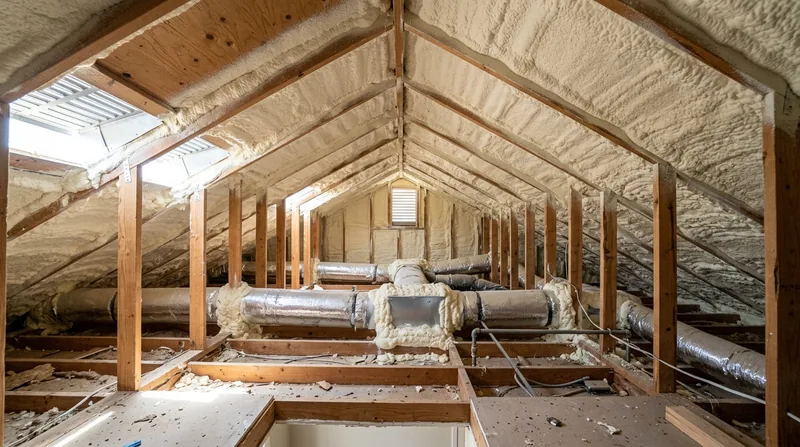




Attic spray foam insulation in Midland addresses the real problem: West Texas sun bakes your attic deck to 150 degrees or higher, and that heat radiates down through fiberglass or cellulose into your living space, forcing your air conditioning to run longer and harder. Midland sits on flat high plains where nearly every house, from mid-century brick ranches in older parts of Midland County to newer subdivisions spreading toward Ector County, sits on a slab-on-grade foundation with ductwork running through a vented attic. Summer highs that push past 100 degrees turn those vented attics into convection ovens. Winter brings hard freezes and sudden cold snaps that expose the same air leaks the summer heat found first. Spray foam seals the attic deck, closes penetrations and top plates, and creates a thermal and air barrier that stops both heat gain and loss at the source. The result is lower cooling bills, more even temperatures, and an attic that stops working against your HVAC system. We spray closed cell spray foam to R-values that match your climate and your load, with mechanical ventilation during cure and a honest re-entry window. Call us at (432) 400-5155 for a free estimate with R-value and thickness specs in writing.
Why Attic Spray Foam Insulation Matters in Midland: Heat, Air Leaks, and Energy Bills
Midland's climate is hot and dry, not humid like the Gulf Coast, so vapor drive stays mild. The real enemy is heat gain through the attic deck and walls, plus dust and wind-driven air finding every gap around penetrations and top plates. A vented attic does not stop either one. Fiberglass and cellulose blow-in insulation slow conductive heat, but they do not seal air leaks, and they do not stop radiant heat from sheet metal ductwork baking in the sun. Your back bedrooms never seem to cool down because the attic ductwork is fighting sun-loaded metal, and your unit runs all night trying to overcome a load that started in the attic at 2 p.m.
- Closed cell spray foam creates an air barrier and a thermal barrier in one pass, cutting heat gain before cooling bills spike.
- Sealing top plates and penetrations stops wind-driven dust and outside air from leaking into the attic and down into your home.
- Spray foam adheres to rafters, joists, and ductwork, and does not settle or compress like blown-in insulation over time.
- A sealed attic deck protects ductwork from dust, caliche, and temperature swings, extending equipment life and improving cooling performance.
Air leaks and radiant heat are why Midland homeowners see cooling bills spike in June and stay high through August, even after they have replaced their air conditioning unit.
Local example: A ranch home in central Midland with a 1,400 sq ft attic, vented and insulated with fiberglass batts, sees cooling bills of $280 to $320 per month in July and August. Spray foam sealing the deck and closing penetrations cuts that load by 25 to 35 percent because the attic no longer leaks cool air and the ductwork no longer radiates heat into the space below.
For more on how we seal air leaks across the rest of your home, see air sealing in Midland.
How We Install Attic Spray Foam Insulation: The Process in Midland Homes
Installation begins with a site visit and a honest assessment of what is already in your attic, what needs to come out, and what R-value and thickness the space calls for. We do not spray over wet insulation, contaminated substrates, or active roof leaks. If moisture or damage is present, we walk away until it is fixed. Once the attic is ready, we set up mechanical ventilation, protect areas that need it, and spray the foam in controlled passes to the specified thickness. The foam cures in 24 to 48 hours, during which the space must stay unoccupied and ventilated. After cure, the attic is safe to re-enter and use as storage or for ductwork access.
- We inspect the attic and existing insulation, identify air leaks, and take measurements to calculate R-value and board feet.
- We remove old, failed, or contaminated insulation if the job calls for it, and dispose of it responsibly.
- We seal top plates, penetrations, and rim joists with foam or caulk before spraying the main deck.
- We spray closed cell foam at the specified thickness and R-value, usually 4 to 6 inches for Midland attics, depending on your current insulation and your target performance.
- We run mechanical ventilation during cure and provide a clear re-entry window and care instructions.
The whole job typically takes one to two days on site, depending on attic size and the extent of air sealing needed.
Midland example: A 1,600 sq ft attic in West Odessa with existing fiberglass batts and a leaky top plate around a bath vent stack takes one day to air seal and spray. We remove the old batts, seal the top plate and all penetrations, spray 5 inches of closed cell foam to R-30, and the homeowner can re-enter the next morning.
If your attic also needs work on crawl spaces or rim joists, see crawl space spray foam insulation and rim and band joist spray foam.
| Approach | Description | Best for |
|---|---|---|
| Closed Cell Spray Foam | High-density foam, 1.5 to 2 lb/cu ft, R-6 to R-7 per inch. Air barrier and thermal barrier in one layer. Adheres to all surfaces. | Sealed attics, ductwork protection, condensation control on metal, dust and air leak sealing in West Texas climates. |
| Open Cell Spray Foam | Low-density foam, 0.4 to 0.5 lb/cu ft, R-3.5 to R-4 per inch. Vapor-open, absorbs sound, lower cost per board foot. | Attic top-ups where existing insulation is sound, garage ceilings, sound dampening, budget-conscious retrofit. |
| Blown-In Fiberglass or Cellulose Top-Up | Thermal insulation only, does not seal air leaks. Settles over time. Lowest upfront cost. | Simple R-value boost in attics with no major air leaks, no moisture, and no ductwork performance issues. |
| Insulation Removal and Replacement | Strip out old, failed, or contaminated insulation; air seal and spray foam. Full retrofit. | Attics with settled fiberglass, old cellulose, moisture damage, or air leaks that blown-in alone will not fix. |
Attic Spray Foam Insulation Cost in Midland: What to Expect
Pricing for attic spray foam insulation in Midland starts at $1.50 per square foot and typically ranges from $1.50 to $2.50 per square foot installed, depending on the scope. A 1,400 sq ft attic with existing insulation removal, top plate sealing, and 5 inches of closed cell foam runs $2,100 to $3,500. Factors that move the price up include the amount of air sealing needed (penetrations, rim joists, band joists), the thickness and R-value specified, whether old insulation has to come out, and access difficulty. A simple top-up of a sound attic with open cell foam costs less. A full retrofit with removal, extensive air sealing, and closed cell foam costs more. The best way to know your actual cost is to get a written estimate from us with R-value and thickness specified in square feet and board feet. We will also tell you how much of that cost is labor, materials, and any removal or disposal fees. See our full pricing overview for more detail on what drives cost in your specific job.
Attic Spray Foam Insulation Near Me: What Midland Homeowners Should Know Before Hiring
Spray foam insulation is not a commodity, and the difference between a professional installation and a rig-and-run job is enormous. Some contractors show up with an out-of-state trailer, spray an attic in an afternoon, and disappear when the smell will not go away or the foam shrinks. Others are national franchises with no local accountability. We are a local shop with a local address and a track record in Midland since 2013. Before you hire any spray foam contractor, verify that they are fully insured and ask for a current certificate of insurance naming you as additional insured. Ask for references from Midland homeowners and call them. Get a written estimate that specifies the R-value, the thickness in inches, the total board feet, and the cost. If an estimate has no R-value and no thickness, walk away. Ask what the re-entry window is and whether mechanical ventilation will run during cure. If a contractor promises immediate re-entry or tells you the foam is non-toxic and safe to breathe, do not hire them. Spray foam requires 24 to 48 hours of ventilation and a clear re-entry window. Understand what permits your city or county requires before work begins. Many Midland homeowners do not realize that contractor registration varies from city to city across Greater Midland, and there is no reciprocity. Ask any contractor whether they hold the registration your city requires, and verify it before work starts. Call the Midland building department or your city's permit office if you are unsure what applies at your address. For a free, no-obligation estimate with a written scope and pricing, call us at (432) 400-5155 or visit our contact page.
Attic Spray Foam Insulation in Midland: Pricing Guide
| Service | Price | Details |
|---|---|---|
| Attic Spray Foam, Closed Cell | Starting at $1.50/sq ft | Sealed attic deck with 4 to 6 inches closed cell foam, air sealing of top plate, R-value and thickness specified in writing |
| Attic Spray Foam, Open Cell | Starting at $1.20/sq ft | Top-up or full attic coverage with open cell foam, sound dampening, lower cost, best for existing sound insulation needing R-value boost |
| Insulation Removal and Replacement | On estimate | Removal of old fiberglass or cellulose, disposal, air sealing, and new foam spray; price depends on attic size and contamination level |
| Travel and Estimates | Included in Midland area | No separate mileage fee or travel charge for Midland, Odessa, West Odessa, Stanton, Gardendale, Andrews, Big Spring, Lamesa, and surrounding areas |
| Free Written Estimate | No charge | On-site visit, R-value and thickness specs, board feet calculation, and firm pricing; response within 24 hours at (432) 400-5155 |
Indicative pricing, the exact cost depends on square footage, finish, and site access. Free personalized estimate within 24h at (432) 400-5155.


