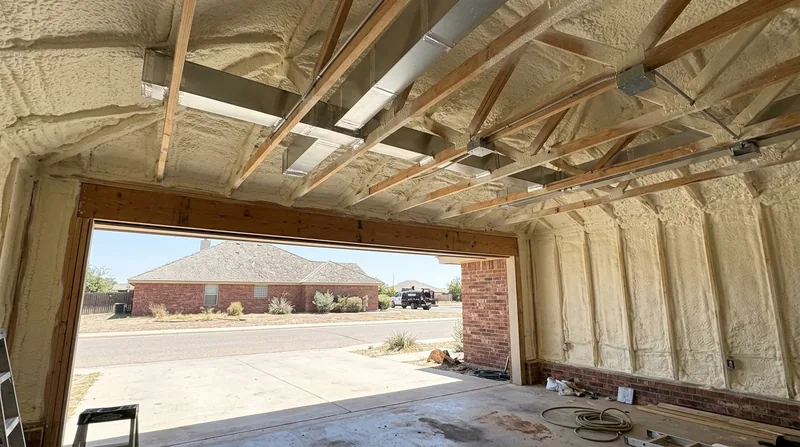




Garage spray foam insulation in Midland turns a workspace that bakes at 100 degrees in summer and freezes hard in winter into a usable workshop year-round. Midland sits on the flat high plains of the Permian Basin, where most homes rest on slab-on-grade foundations and garages take the same brutal solar load and temperature swings as the rest of the house. A vented garage ceiling and exposed walls lose conditioned air through every seam, and the thermal mass of concrete floors and metal door frames conducts heat straight through to the interior. Spray foam seals the ceiling and walls, stops the radiant heat, and keeps the garage stable enough to work in, store tools, or park a vehicle without watching the temperature swing 40 degrees between noon and sunset. We have been foaming Midland garages since 2013, and we know the job: controlled application, proper ventilation during cure, and a written estimate that names the R-value and thickness you are paying for.
Why Garage Spray Foam Insulation Matters in the Permian Basin Heat
A standard Midland garage ceiling runs uninsulated or carries a thin layer of fiberglass that settles, gaps, and lets the attic temperature swing 130 degrees between summer and winter. The walls are typically single-layer brick or metal studs with no thermal break. In summer, that ceiling radiates heat into the garage all afternoon, and in winter, a cold snap pulls warmth straight through the walls and out of the slab. A garage that is not conditioned becomes a heat sink in summer and a cold box in winter, and anything stored there (tools, batteries, paint, vehicles) suffers. Spray foam stops both modes: it insulates the ceiling against solar gain, it seals the walls against infiltration, and it maintains a stable interior temperature that protects your investment and makes the space livable.
- Foam insulation on the garage ceiling stops radiant heat from the attic and keeps the space 15 to 25 degrees cooler on a 100-degree Midland summer day.
- Sealing the rim joist and top plate with foam stops air leakage and dust infiltration that wind-driven caliche and West Texas dirt push through every gap.
- Closed cell spray foam on walls and ceilings provides condensation control, so moisture from temperature swings does not rot framing or encourage mold.
- A foamed garage stays usable as a workshop, storage area, or vehicle shelter without running a separate HVAC system to condition it.
The result is a garage that does not lose your tools to heat and cold, does not funnel dust into your home, and stays comfortable enough to work in during the shoulder seasons.
Key info: Midland garages attached to the home often share wall cavities with the house. Foam on the garage side of that wall also improves the thermal performance of the adjacent bedroom or living space, so a garage insulation job often pays a bonus in home comfort.
For more on how foam controls temperature and air leakage across your whole home, see our attic spray foam insulation service, which applies the same principle to the biggest heat loss zone in any Midland house.
How We Insulate Midland Garages: The Step-by-Step Process
Garage foam starts with a site walk and a clear understanding of what you are trying to achieve: cooler summers, warmer winters, dust control, or all three. We assess the garage ceiling for any existing insulation, check the condition of the rim joist and top plate where the garage walls meet the attic, and identify any ductwork or penetrations that need protection. We then recommend a foam type (closed cell for maximum R-value and condensation control, or open cell for cost efficiency on a simpler ceiling) and a thickness that meets your goals and your budget. Once you approve the estimate, we set up mechanical ventilation, apply the foam in controlled passes, and let it cure for 24 to 48 hours before you re-enter the space.
- We inspect the garage ceiling, walls, and rim joist to confirm substrate condition and identify any existing insulation that must be removed first.
- We install mechanical ventilation to exhaust VOCs during application and cure, so odor does not enter your home or linger in the garage.
- We apply closed cell or open cell foam in thin passes, controlling thickness and density so the material cures evenly and reaches its rated R-value.
- We install a thermal barrier (drywall, intumescent paint, or foam-rated finish) where building code requires it, protecting the foam from ignition.
- We air seal penetrations, gaps around electrical boxes, and the top plate where the garage meets the attic, stopping air movement and dust infiltration.
The entire process takes one to three days depending on garage size and whether removal of old insulation is needed. Once cured, the foam is permanent, does not settle, and requires no maintenance.
Example: A two-car garage in Midland with an uninsulated ceiling and single-layer brick walls typically takes one day to foam the ceiling and rim joist with closed cell. If old fiberglass or blown-in insulation must be removed first, add a half day for removal and cleanup. See our insulation removal service for details on clearing the space before we spray.
Garage Spray Foam Insulation Methods: Closed Cell vs. Open Cell
| Approach | Description | Best for |
|---|---|---|
| Closed Cell Spray Foam | Dense, rigid foam with an R-value of 6.5 to 7 per inch. Stops air and moisture movement. Cures in 24 hours. Stronger and more durable than open cell. | Garages with extreme temperature swings, metal buildings, condensation risk, or where maximum R-value in minimal thickness is needed. |
| Open Cell Spray Foam | Softer, semi-rigid foam with an R-value of 3.5 to 3.8 per inch. Allows moisture to pass through. Lower cost. Cures in 24 to 48 hours. | Garages where cost is the primary driver, ceiling-only jobs, or where condensation is not a concern. |
| Closed Cell on Rim Joist Only | Hybrid approach: closed cell foam seals the rim joist and top plate where the garage meets the attic, stopping air leakage and condensation. Ceiling can be open cell or fiberglass top-up. | Garages where air sealing is the main goal and a full ceiling re-insulation is not needed. Common retrofit on sound existing insulation. |
| Removal and Replacement | Old fiberglass, blown-in, or failed foam is removed, the cavity is cleaned, and new foam is applied. Ensures no voids or settling. | Garages with existing insulation that has settled, been damaged, or is blocking airflow. Mandatory before any retrofit on a saturated attic. |
Closed cell is the standard choice for Midland garages because the Permian Basin heat and cold swings create condensation risk, and closed cell stops both air and moisture. Open cell works for simple ceiling-only jobs where cost matters and condensation is not a factor. We write a detailed estimate for each approach, naming the R-value, thickness, and material so you can compare apples to apples.
Garage Spray Foam Insulation Cost in Midland: What to Expect
Garage spray foam insulation in Midland starts at $1,200 for a basic two-car ceiling with closed cell foam at 3 to 4 inches, which delivers an R-value of 20 to 28. The price moves up based on garage size, the extent of rim joist and wall sealing, whether old insulation must be removed first, and the foam type you choose. A three-car garage or a job that includes wall foam and full air sealing typically runs $1,800 to $2,500. Removal of existing insulation, if needed, adds $300 to $600 depending on the volume and type of material being cleared. We provide a written estimate that breaks down the R-value, thickness, and cost per section, so you know exactly what you are paying for and why.
Factors that affect your final cost include the following:
- Garage size and ceiling height determine the square footage of foam needed and the labor time required.
- Existing insulation that must be removed adds time and disposal cost before we can spray new foam.
- Rim joist and wall sealing beyond the ceiling increases material volume and application time.
- Access and ductwork or penetrations that need protection around the foam add complexity and care.
- Closed cell versus open cell: closed cell runs 30 to 40 percent higher per board foot but delivers more R-value per inch and stops condensation.
We recommend getting 2 to 3 estimates from local spray foam contractors so you can compare R-value, thickness, and price. A low bid with no R-value spec and no thickness detail is a red flag. For a detailed pricing breakdown and examples from other Midland garages, see our full pricing page.
Garage Spray Foam Insulation Near Me: What Midland Homeowners Should Know Before Hiring
Hiring a spray foam contractor is a straightforward decision once you know what to ask. Start by confirming that any contractor you contact is fully insured and carries general liability coverage that protects your home during the work. Ask for a written estimate that includes the R-value, thickness, and foam type, and do not accept a price without those details. Verify that the contractor has a local address and can be reached after the job is done in case questions arise about cure time or odor. In Midland, contractor registration requirements vary by city and county, so ask your contractor what registration their city or county requires and request proof of it before work begins. Do not assume that all spray foam installers follow the same standard: the difference between a careful, ventilated application and a sloppy one is the difference between a garage you can use in 24 hours and one that smells for weeks.
- Request references from recent garage jobs in Midland or nearby, and call at least one to ask about cure time, odor, and the contractor's responsiveness.
- Confirm that mechanical ventilation will be in place during application and cure, so fumes do not enter your home.
- Get a written timeline for the job and a clear re-entry window (typically 24 to 48 hours after cure is complete).
- Ask about the warranty on workmanship and what it covers if the foam settles or fails to cure evenly.
- Verify insurance and ask for a certificate of insurance naming your address as the job location.
We are fully insured and have served Midland since 2013. We provide a free estimate with no obligation, and we can be reached at (432) 400-5155 to answer questions before, during, and after the job. To schedule your free estimate, contact us online or call today.
Garage Spray Foam Insulation in Midland: Pricing Guide
| Service | Price | Details |
|---|---|---|
| Two-car garage ceiling, closed cell, 3-4 inches | Starting at $1,200 | Includes R-value 20-28 on ceiling, mechanical ventilation during cure, 24-48 hour re-entry window |
| Three-car garage or ceiling plus rim joist sealing | Starting at $1,800 | Expands coverage to include air sealing at top plate and rim joist where garage meets attic, reducing infiltration |
| Removal of existing insulation plus new foam | Starting at $1,500 | Includes hauling and disposal of old fiberglass or blown-in material, cleanup, and full ceiling foam application |
| Walls, open cell option, or complex retrofit | On estimate | Site inspection required to assess wall access, existing material, ductwork, and scope before pricing |
| Travel and estimate | Included and free | No mileage charge in Midland and surrounding service areas, free written estimate within 24 hours |
Indicative pricing, the exact cost depends on square footage, finish, and site access. Free personalized estimate within 24h at (432) 400-5155.


