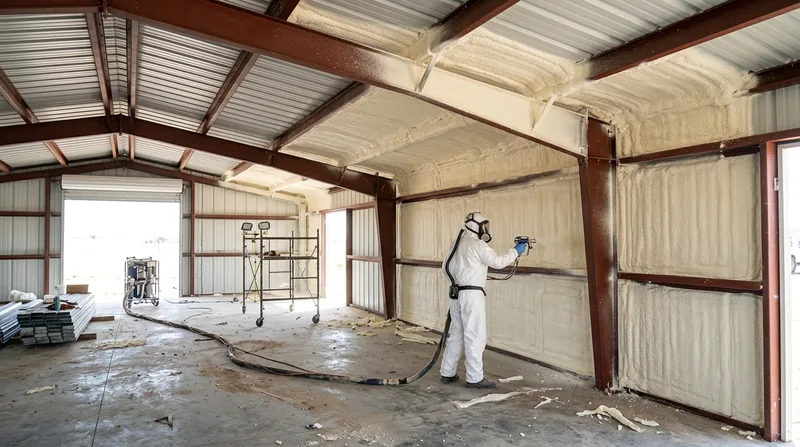




Closed cell spray foam insulation in Midland works because it handles what the high plains throw at you: heat that climbs past 100 degrees in summer, hard freezes in winter, and wind-driven dust that finds every gap. Metal shops, oilfield yards, and the barndominiums scattered across Midland and Ector counties depend on closed cell to hold temperature and stop air infiltration where open cell would let both pass through. We apply it in controlled passes, holding substrate temperature and board thickness right for West Texas heat, so the foam cures dense and stable without the smell that lingers for weeks when the work is rushed. Closed cell delivers the R-value per inch that tight spaces demand, and it stands up to the temperature swings that make this part of the Permian Basin hard on insulation. If your attic ductwork runs hot in July and your rim joists frost in January, or if you are sealing a metal building where condensation is the real enemy, closed cell is the answer. Learn what we do across all insulation and air sealing services, or call us at (432) 400-5155 for a free estimate.
Why Closed Cell Spray Foam Matters in Midland's Heat and Wind
Midland sits on flat, exposed high plains where summer heat bakes vented attics and winter cold snaps crack weak seals. The older brick ranches and mid-century homes that fill much of Midland County sit on slab-on-grade foundations with ductwork running through attics that were never sealed, and the newer subdivisions pushing toward Ector County carry the same vulnerability. Closed cell foam stops the heat gain that forces air conditioning to run all day, and it blocks the air leaks that let dust and wind find their way into living spaces. Unlike open cell, which stays soft and permeable, closed cell is rigid, moisture-resistant, and holds its R-value in the temperature swings that define West Texas.
- Closed cell delivers 6 to 7 R-value per inch, so you get high performance in shallow cavities where fiberglass would need twice the depth.
- The rigid foam acts as a secondary air barrier, sealing gaps around ductwork, penetrations, and rim joists that fiberglass leaves open.
- Closed cell resists moisture, so it will not absorb water if a roof or crawl space gets wet before the foam is applied.
- The dense structure blocks wind-driven dust and caliche that blow through every gap in metal buildings and oilfield structures.
- Once cured, closed cell holds its shape and R-value through the 70-degree temperature swings between day and night that Midland sees in spring and fall.
In Midland's climate, controlling heat gain through the attic deck and stopping air infiltration at the envelope are the two biggest drivers of energy cost and comfort, and closed cell does both.
Key info: A metal shop in Midland or a barndominium in Andrews that swings between 100-degree days and 30-degree nights will see condensation on uninsulated steel if the interior air is humid. Closed cell foam, sprayed to the interior of the metal shell, stops that condensation by keeping the steel warm on the inside. Open cell cannot do this because it stays soft and permeable to moisture vapor.
For permitting and code compliance in your city or county, contact us for a free estimate and we will help you understand what your local building department requires. Texas regulates contractors at the municipal level, so requirements vary by city. We work with your local building official to ensure all work meets code.
How We Apply Closed Cell Spray Foam in Midland Attics and Metal Buildings
Closed cell foam is sprayed in controlled passes, building thickness one layer at a time. Each pass must be thin enough that the exothermic reaction stays managed, the foam cures evenly, and the substrate temperature stays within the manufacturer range. We set up mechanical ventilation during cure to move vapors out of the space, and we enforce a re-entry window of 24 to 48 hours before the space is occupied. The difference between a professional installation and a rushed job is the difference between a smell that fades in a few days and a chemical odor that lingers for weeks.
- We measure substrate temperature and air temperature to ensure conditions are right before we spray.
- We apply foam in thin passes, checking thickness with a depth gauge after each layer cures.
- We verify that the manufacturer ratio and drum temperature are correct before we start, so the foam expands and cures to the right density.
- We set up exhaust ventilation to move fumes out during cure and for 24 to 48 hours after spraying is done.
- We do not allow re-entry or occupancy until the cure window is complete and the space is safe.
This discipline is what separates a professional installation from a rig-and-run crew that sprays an attic in an afternoon and disappears when the smell will not go away.
Example: A sealed attic retrofit in Midland or Odessa starts with air sealing the rim joist and any ductwork penetrations, then we spray closed cell to the roof deck in controlled passes. We build thickness from 4 to 6 inches, measuring as we go. The result is a sealed, insulated attic that holds temperature and blocks air infiltration, so ductwork stays cooler in summer and warmer in winter. Read more about sealed attic spray foam insulation.
Closed Cell Spray Foam Methods and Applications
| Application | Description | Best For |
|---|---|---|
| Sealed Attic Roof Deck | Closed cell sprayed directly to the underside of roof sheathing, creating an unvented attic with no soffit vents or ridge vents. | Vented attics in Midland that leak hot air in summer and cold in winter; ductwork that runs through the attic. |
| Metal Building and Pole Barn Interior Shell | Closed cell sprayed to the inside surface of metal walls and roof, creating a thermal and moisture barrier on the steel. | Metal shops, oilfield yards, and barndominiums where condensation forms on uninsulated steel in temperature swings. |
| Rim Joist and Band Joist Sealing | Closed cell foam injected or sprayed into the rim cavity where the band joist meets the foundation, sealing the thermal boundary. | Slab-on-grade homes in Midland where rim joists are exposed to outside air and account for significant heat loss. |
| Crawl Space Walls and Headers | Closed cell applied to crawl space rim joists, band beams, and foundation walls, creating a sealed thermal boundary. | Crawl spaces where moisture and temperature control are needed; often paired with a vapor barrier on the floor. |
| Wall Cavity Injection Retrofit | Closed cell foam injected into existing wall cavities of older homes without removing drywall or siding. | Pre-1980 brick ranches in Midland with hollow walls, no insulation, and high heating and cooling costs. |
| Garage Ceiling and Walls | Closed cell sprayed to garage ceiling framing and exterior walls to reduce heat loss to the garage space. | Attached garages in Midland where the garage becomes a thermal sieve in winter and a heat sink in summer. |
Each application is measured and sized on site. We do not use a generic formula; we look at the cavity depth, the substrate temperature, the air temperature, and the local code requirements, and then we specify the thickness and R-value your job needs.
Closed Cell Spray Foam Insulation Cost in Midland: What to Expect
Closed cell spray foam in Midland typically starts at $1.20 per board foot and can range higher depending on job complexity, access, substrate condition, and the thickness required by code and by your climate zone. A straightforward sealed attic retrofit on a 1,500-square-foot home might run $2,500 to $4,500, while a metal building or barndominium with a larger footprint and thicker foam will cost more. An injection foam retrofit of an older brick ranch's hollow walls runs $1,500 to $3,000 depending on the square footage of wall to fill. Rim joist and band joist sealing on a typical Midland slab-on-grade home runs $500 to $1,200. The real variables are the area to be sprayed, the thickness required, access and logistics, and whether existing insulation must be removed first.
Getting two or three written estimates is always smart. Each estimate should specify the R-value you will get, the thickness in inches, the square footage or board feet to be covered, and the total price. If an estimate omits R-value and thickness, or quotes a price far below market with no detail, that is a signal to dig deeper. Visit our pricing page for more detail on what moves the cost up or down.
Call us at (432) 400-5155 for a free estimate. We will come out, measure the space, understand what code applies at your address, and give you a written quote with R-value and thickness spelled out. There is no obligation to book, and we respond within 24 hours.
Closed Cell Spray Foam Insulation Near Me: What Midland Homeowners Should Know When Hiring a Contractor
Hiring a spray foam contractor is a decision that affects your home's comfort and energy cost for years. The spray foam trade has two kinds of bad actors: rig-and-run crews that come from out of state, spray a job in an afternoon with no ventilation or care, and disappear when the smell will not go away; and national franchises that use high-pressure sales and promise energy savings and warranties that the product cannot deliver. A local independent shop with a local address, local insurance, and a reputation in Midland is your best bet. Here is what to check before you hire anyone.
- Verify that the contractor carries full insurance (general liability and workers compensation) and ask to see the certificate before work starts.
- Check whether your city or county requires contractor registration or a permit for insulation work, and confirm that any contractor you hire meets those requirements before you sign a contract.
- Ask for written estimates from at least two contractors, and make sure each one specifies R-value, thickness in inches, and the total price with no hidden fees.
- Ask for references from recent jobs in Midland or nearby towns, and call them to ask about the smell, the timeline, and whether the contractor showed up if problems arose after the job was done.
- Understand that spray foam requires mechanical ventilation during cure and a re-entry window of 24 to 48 hours; if a contractor promises immediate re-entry or says ventilation is not needed, that is a red flag.
- Ask about the manufacturer of the foam system and whether the contractor can provide technical support if questions arise after the job is complete.
The honest contractor will tell you when a cheaper option (like blown-in fiberglass) is the right answer for your job, will not promise energy savings you cannot verify, and will walk away if the substrate is wet or contaminated. That straight talk is a sign of a professional, not a weakness. Contact us for a free estimate and to ask any questions about how we work.
Closed Cell Spray Foam Insulation in Midland: Pricing Guide
| Service | Price | Details |
|---|---|---|
| Sealed Attic Retrofit (Closed Cell) | Starting at $1.20/board ft | Typical 1,500 sq ft home runs $2,500 to $4,500 depending on roof pitch and ductwork penetrations |
| Metal Building or Barndominium Interior Shell | Starting at $1.20/board ft | Larger footprint and thicker foam for condensation control; cost scales with building size and wall height |
| Wall Cavity Injection Retrofit (Hollow Walls) | Starting at $1.50/board ft | Older brick ranches in Midland; cost depends on total square footage of wall cavities to be filled |
| Rim Joist and Band Joist Sealing | Starting at $500 | Typical slab-on-grade home rim joist runs $500 to $1,200 depending on perimeter and access difficulty |
| Crawl Space Rim and Header Sealing | On estimate | Requires on-site inspection to assess substrate condition, moisture, and linear feet of rim joist to seal |
| Free Estimate | No charge | Written quote with R-value and thickness specified; response within 24 hours at (432) 400-5155 |
Indicative pricing, the exact cost depends on square footage, finish, and site access. Free personalized estimate within 24h at (432) 400-5155.


